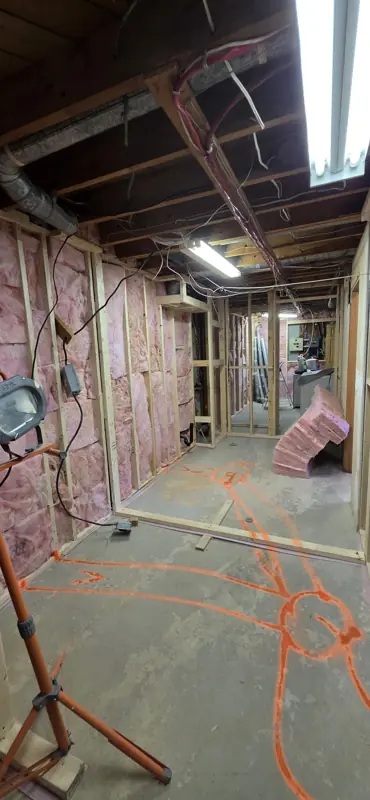
Step 1: check the slab before choosing anything
Concrete basement slabs can carry moisture from the ground, especially in older houses. Before any flooring decision we look for signs of water: white mineral deposits, stains, a musty smell, cracks that let water in during the spring thaw. A simple test is to tape a square of plastic on the slab for a day or two: drops under the plastic mean moisture is coming up through the concrete.
If there is an active water problem, fix it first (drainage, crack repair, French drain). Flooring never fixes water.
Step 2: the subfloor
Over a dry slab, a dimpled-membrane subfloor panel or a membrane with a floating floor lets air move under the floor and adds a little warmth. In tight ceiling heights, a thin membrane keeps more headroom. A raised subfloor also makes the floor feel less cold underfoot, which matters in a Quebec winter.
Step 3: the floor itself
Luxury vinyl plank (LVP) is our usual pick for basements: waterproof, warm-looking, comfortable and easy to replace plank by plank. Porcelain tile is the most durable and works well with an electric heated floor, ideal in a basement bathroom or laundry. Engineered hardwood can work over a proper subfloor in a dry basement; solid hardwood should be avoided below grade. Laminate looks good but its core swells if it gets wet, so we only use water-resistant types and only in dry basements. Carpet is warm, but it holds moisture and odours if anything goes wrong.
Rough ranking by moisture tolerance: porcelain tile and vinyl plank first, engineered wood next, laminate after, carpet last.
Do not skip radon
Health Canada recommends that every home be tested for radon, a radioactive gas that comes from the ground and is found at higher levels in basements. A long-term test over the winter months is the recommended method. If you are finishing a basement, it is the best moment to test, because mitigation is easier before the walls and floor are closed.
Permits
In Laval, a permit is needed when a basement renovation changes the number of rooms or the structure; replacing a floor alone does not need one. In Montreal, rules depend on your borough. We confirm it for your address.
Planning this project?
Tell us about it in 60 seconds or call 514-241-4530. We visit, measure and send a fixed price with a dated schedule. The visit is free in the West Island; elsewhere a visit fee applies based on your location.
